


By Lito B. Zulueta
IMPRESSIONISM casts its luminous spell on Southeast Asia through Into the Modern: Impressionism from the Museum of Fine Arts, Boston, a major exhibition now on view at the National Gallery Singapore (NGS) until March 1.
Featuring masterworks by Claude Monet, Pierre-Auguste Renoir, Camille Pissarro, Edgar Degas, and other pivotal figures of 19th century French modern art, the show traces how Impressionism transformed the way artists saw light, modern life, and the everyday.
Following NGS’s 2017-2018 Musée d’Orsay exhibition, Colors of Impressionism, this new show is on a far grander scale, bringing together over 100 works by 25 artists — including an exceptional group of 17 paintings by Monet — making it Southeast Asia’s largest-ever exhibition of French Impressionism.
SWEEPING CHANGERather than presenting Impressionism as a self-contained style, Into the Modern frames the movement as a response to sweeping historical change. Organized into seven thematic sections, it traces how artists engaged with urbanization, new technologies such as photography, shifting social rhythms, and a renewed impulse to record nature in an increasingly industrial world.
The exhibition opens with “Seeking the Open Air,” which situates Impressionism in mid-19th century France, when railways and industrial expansion were rapidly reshaping the landscape. Artists associated with the Barbizon School, such as Théodore Rousseau, turned to outdoor painting as both aesthetic renewal and an early form of cultural preservation.
“Plein Air Impressionism” foregrounds the material conditions that enabled the movement. Portable easels, paint tubes, and lighter equipment freed artists from the studio, allowing them to capture light, weather, and fleeting perception directly.
In “Labor and Leisure on the Water,” rivers and coastlines emerge as social crossroads where traditional labor intersects with modern leisure, reflecting new patterns of mobility shaped by industrial life.
“Shared Ambitions” emphasizes the collective spirit of Impressionism, highlighting artistic networks, joint exhibitions, and shared experimentation rather than solitary rebellion.
Urban life comes into focus in “Modern Encounters,” where cafés, boulevards, and theaters are seen through the lens of the flâneur. Cropped compositions, informed by photography, convey the speed and anonymity of the modern city.
“Reimagining the Commonplace” elevates everyday scenes through radical framing and color. The exhibition concludes with “Monet — Moment and Memory,” a meditation on time and perception, where serial images turn fleeting impressions into enduring visual memory.
BEHOLD LISTAmong the highlights of the Singapore exhibition is Rousseau’s Edge of the Woods (Plain of Barbizon near Fontainebleau) (c. 1850-1860), which anticipates Impressionism through its commitment to plein air observation. Painted directly from nature, it abandons academic idealization in favor of textured brushwork and shifting light, foregrounding atmosphere and immediacy.
Degas’ At the Races in the Countryside (1869) captures modern life through a cropped, almost photographic composition. Though Degas resisted the Impressionist label and preferred studio practice, the painting — shown at the first Impressionist exhibition — embodies the movement’s fascination with contemporary leisure, motion, and unconventional viewpoints.
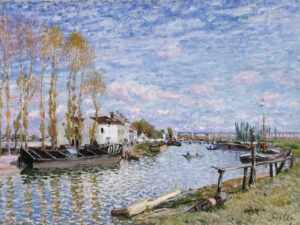
Alfred Sisley’s The Loing at Saint-Mammès (1882) exemplifies Impressionism’s lyricism, using shimmering color and fluid brushstrokes to register fleeting light across water and sky.
Renoir’s Dance at Bougival (1883), by contrast, represents the movement at its most exuberant, with broken brushstrokes, warm light, and soft contours animating urban leisure and sensual pleasure.
In White Flowers in a Bowl (1885), Berthe Morisot demonstrates her mastery of still life, capturing the delicacy of petals, glass, and water through loose, fluid brushwork.
Pissarro’s Two Peasant Women in a Meadow (1893) reflects his sustained engagement with rural labor, while Monet’s The Water Lily Pond (1900) distills Impressionism into visual poetry, dissolving form into light, reflection, and color.
IMPRESSIONISM IN SINGAPORE, PHLIn Singapore, the Nanyang art movement of the 1940s to the 1960s is often associated with Impressionism but is more accurately rooted in Post-Impressionism. Artists such as Georgette Chen and Liu Kang, both trained in Paris, absorbed the structural and expressive lessons of Cézanne, Gauguin, Van Gogh, and Matisse.
Chen emphasized volume, texture, and rhythmic brushwork, reflecting a Cézannian concern for form, while Liu’s mature Nanyang works used non-naturalistic color, flattened space, and bold outlines to merge Western modernism with Southeast Asian subjects.
In the Philippines, Impressionism had only an indirect impact, as academic realism prevailed during the American colonial period.
Modern European ideas entered largely through Victorio C. Edades, who encountered Impressionist and Post-Impressionist works while studying in the US, still enraptured by the 1913 Armory Show that displayed works by Cezanne and Gauguin.
Edades’ modernist advocacy at the University of Santo Tomas (UST) encouraged experimentation, shaping later artists such as Ibarra de la Rosa, who studied at UST and later taught at the Philippine Women’s University, where his students included Hermes Alegre, renowned for his Post-Impressionist women figures.
Impressionism thus reached the Philippines refracted through modernism rather than direct transmission.
Enhanced by contemporary exhibition design, archival materials, and interactive ARTelier spaces tracing Impressionism’s legacy in Southeast Asia, Into the Modern presents the movement not as a closed chapter but as an ongoing conversation.