
By Abigail Marie P. Yraola, Deputy Research Head
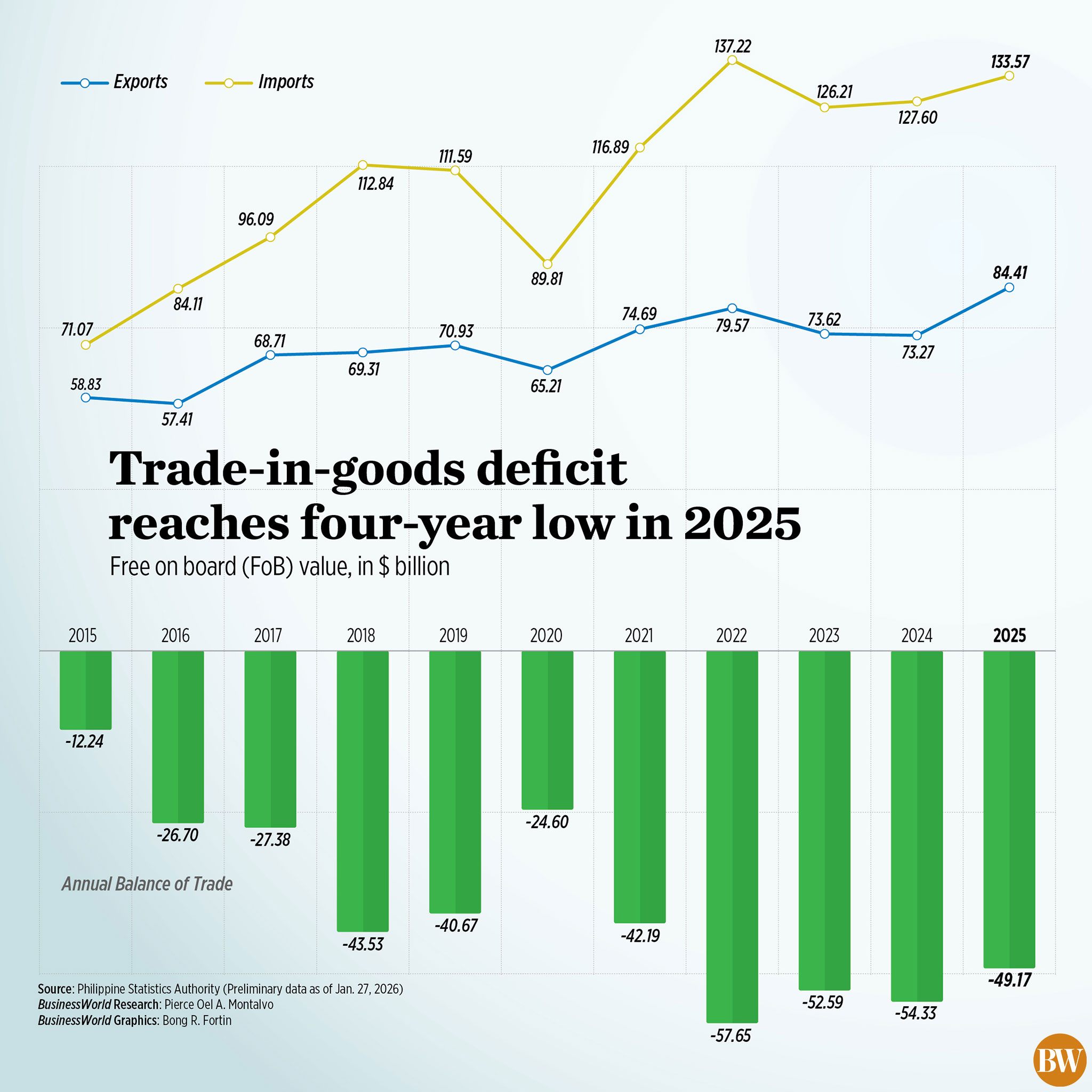
THE Philippines’ trade-in-goods deficit narrowed to a four-year low in 2025, as exports rose by double-digits and import growth remained muted, the Philippine Statistics Authority (PSA) reported on Tuesday.
Analysts said that the narrower trade deficit may have helped provide a modest lift to gross domestic product (GDP) growth in 2025.
Preliminary data from the PSA showed the country’s trade deficit fell by 9.5% year on year to $49.17-billion deficit in 2025, smaller than the $54.33-billion gap a year earlier.

This was the smallest trade gap in four years or since the $42.19-billion deficit in 2021.
Merchandise exports climbed by 15.2% to $84.41 billion last year, better than the government’s projection of a 2% decline. The rise in exports was a turnaround from the 0.5% contraction in exports in 2024.
Meanwhile, imports grew by 4.7% year on year to $133.57 billion in 2025, faster than the 3.5% growth expected by the government for the year. This was also faster than the 1.1% gain in 2024.
The trade deficit in 2025 shrank year on year due to better-than-expected exports performance and subdued appetite for imports, Marco Antonio C. Agonia, an economist at the University of Asia and the Pacific, said in an e-mail.
“On the exports side, trade uncertainties encouraged export frontloading to duck erratic tariff announcements, [and were] also helped by a weakened peso making exports more cost-competitive,” he said.
Weak domestic demand, following the corruption scandal and consecutive natural disasters, coupled with a depreciated peso, dampened imports, he added.
Miguel Chanco, chief emerging Asia economist at Pantheon Macroeconomics, said the narrowing trade deficit is due to a genuine recovery in exports, which grew by 15% overall compared to the previous year.
“In the second half of 2025, though, this consolidation was helped more by imports underperforming quite considerably, which is great for the trade balance but bad for what it says about the Philippine economy, given that it’s mainly domestic demand driven.”
George T. Barcelon, chairman of the Philippine Chamber of Commerce and Industry (PCCI), said that as the US introduced reciprocal tariffs, orders were held up as businesses were uncertain about how to proceed and what tariff rates would apply.
“At least 19% (tariffs) were considered one of the medium lows on tariffs. So, business continues,” he said in a phone interview.
The United States imposed a 19% reciprocal tariff on Philippine goods beginning Aug. 7.
DEFICIT IN DECEMBERIn December, the trade-in-goods deficit narrowed to $3.52 billion from the $4.15-billion gap in the same month in 2024, declining by 15%.
It was the smallest trade balance in 10 months or since the $2.97 billion logged in February 2025.
Total outbound sales of Philippine-made goods jumped by 23.3% year on year in December to $6.99 billion, faster than the 21.6% growth in November and a turnaround from the 1.9% drop in the same month in 2024.
It was the quickest pace for exports in six months or since the 26.9% increase in June last year.
By value, December export haul was the highest in two months or since the $7.45 billion posted in October 2025.
On the other hand, merchandise imports rose by 7.1% year on year to $10.52 billion in December, faster than the 2.3% gain in November and a turnaround from the 1.4% contraction in the same month in 2024.
The import bill was the smallest in 10 months or since the $9.76 billion in February.
For Mr. Agonia, the smaller trade deficit may provide a slight boost to the fourth-quarter and full-year GDP figures, but unlikely to overturn the effect of lower government spending and weak investor and consumer confidence following the corruption scandal.
The PSA will be reporting the fourth-quarter and full-year GDP data on Jan. 29, Thursday.
EXPORTS REBOUNDBy major type of goods, manufactured goods, which made up 80.1% of the total exports, climbed by 15.8% to $67.62 billion in 2025.
By commodity, electronic products, which accounted for more than half of total exports (54.4%) jumped by 17.6% to $45.96 billion last year.
Semiconductors, a subset of electronic products and accounted for the bulk of electronic product sales, rose by 18.7% to $34.62 billion.
“Exports staged a strong rebound in 2025, far outpacing the growth in imports on the back of robust demand for semiconductors,” Chinabank Research said in a research note.
It said exports saw a recovery in 2025 after two years of decline, despite initial concerns that exports would face challenges amid an uncertain global trade environment.
Chinabank Research said overseas demand for semiconductors remained the key driver of exports’ robust year-end performance.
“Global requirements tied to AI (artificial intelligence), electric vehicles, and data centers are expected to continue supporting demand this year,” it added.
Meanwhile, other manufactured goods surged by 31.1% last year to $6.13 billion, followed by machinery and transport equipment which rose by 34.3% to $3.55 billion.
In 2025, the United States was the top export destination for locally made products with a 15.9% share worth $13.44 billion.
It was followed by Hong Kong, which accounted for a 14.6% share ($12.32 billion), Japan with 13.7% share ($11.57 billion), China with 11% share ($9.3 billion) and the Netherlands with 4.3% share ($3.6 billion).
MUTED IMPORT GROWTHRaw materials and intermediate goods, which made up the bulk of the country’s total imports (36.1% share) rose by 3.7% to $48.21 billion in 2025.
Imports of capital goods grew by 13.2% to $40.45 billion in 2025, while consumer goods jumped by 7.3% to $27.71 billion.
By import commodities, electronic products which made up 23.9% of the country’s total imports made up most of the manufactured goods. It rose by 16.7% to $31.94 billion in 2025.
Imports of semiconductors increased by 20.1% to $22.22 billion in 2025.
On the other hand, imports of mineral fuels, lubricants and related materials contracted by 12.5% to $16.69 billion. This accounted for 12.5% share in the country’s total imports.
Imports of transport equipment went up by 10.5% to $12.55 billion last year from $11.36 billion in 2024.
In 2025, China was the country’s biggest source of imports with a 28.6% share worth $38.22 billion. South Korea followed with a 7.9% share ($10.58 billion), Japan with a 7.9% share ($10.52 billion), Indonesia with a 7.6% share ($10.16 billion) and the United States with 6.1% share ($8.11 billion).
“Trade statistics will likely normalize heading into 2026,” Mr. Agonia said as ongoing geopolitical and trade uncertainties continue to weigh on global growth prospects, while base effects from the previous year’s outcomes may impact this year’s trade performance.
Chinabank Research said the country’s export performance this year will likely to be supported by sustained demand for chips related to advanced technologies.
“However, the volatile global landscape — amid renewed US tariff threats and geopolitical tensions — poses a risk to external demand,” it said.
Mr. Chanco said that it will be difficult for the Philippines to replicate the strong growth in exports this year, “with global growth set to slow further and with the imposition of higher US tariffs in the middle of last year likely to be felt more fully.”
“High base effects from the front-loading of shipments to the US, pre-tariff, will act against headline export growth this year,” he added.