


By Katherine K. Chan, Reporter
NERISSA ENRIQUEZ, 55, used to squeeze in a stop at a remittance shop near her Florida hospital after long nursing shifts, wiring small amounts several times a month to relatives in the Philippines.
These days, most of her money goes home through her phone — and she says she’s unlikely to go back to cash counters.
A 1% US tax on certain remittances, which took effect on Jan. 1 under President Donald J. Trump, is pushing overseas Filipinos like Ms. Enriquez further toward digital channels and away from cash-based transfers that fall under the levy.

The change is modest on paper, but for workers who send money frequently, it adds another cost to an already tight budget.
“I’ll probably have to cut back on the amount because of the tax,” said Ms. Enriquez, who has worked in the US for almost two decades. “I need to adjust it based on my income because that’s all I can afford.”
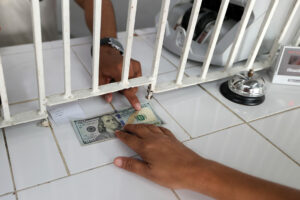
The tax applies to cash-based transfers such as cash payments, money orders and cashier’s checks, regardless of the sender’s citizenship. It is charged on top of the amount sent. Transfers made through US banks, US-issued debit and credit cards, electronic wallets and even hand-carrying physical cash are exempt — a carve-out that is shaping how migrants respond.
While the charge amounts to just $1 for every $100 sent, Ms. Enriquez said the added cost still stings, especially as prices of imported goods in the US remain elevated following Mr. Trump’s tariff push. If forced to rely on traditional channels, she said she may trim what she sends just to keep her usual schedule.
“They will probably end up receiving less,” she said of her family back home. “I feel sorry for them, but that’s all I can do.”
The Philippines is one of the world’s biggest recipients of remittances, with money sent by overseas Filipinos serving as a steady source of household income and a buffer for the economy during global slowdowns. Any policy that touches these flows tends to ripple quickly from migrants’ wallets to grocery bills and school fees back home.
Economists say the US tax is unlikely to derail overall remittance inflows but could shave off some spending power for Filipino households and accelerate a shift that was already under way: the move to digital transfers.
The levy could translate to about P8 billion to P9 billion in foregone spending in the Philippines each year, though the broader effect would be limited, Michael L. Ricafort, chief economist at Rizal Commercial Banking Corp., said.
“It could be a drag, though negligible, on remittance growth and on the local economy,” he said via Viber.
Filipinos sent home $2.91 billion in November — the lowest in two months —bringing cash remittances to $32.11 billion in the first 11 months of the year, according to the Bangko Sentral ng Pilipinas. The US remained the biggest source, accounting for 40% of inflows in 11 months.
The central bank’s forecast of a 3% rise in remittances to $36.6 billion this year remains within reach, Ruben Carlo Asuncion, chief economist at Union Bank of the Philippines, told BusinessWorld. The tax’s narrow scope, he added, limits its bite.
“(The tax’s) macroeconomic impact is likely minimal, as it applies only to cash-based transfers, while digital and bank channels remain exempt,” Mr. Asuncion said in a Viber message.
Still, the policy could change how money is sent, nudging overseas Filipinos toward formal digital platforms and away from informal channels, he pointed out.
That shift is already visible. Digital wallets, banking apps and online money-transfer services have gained ground over the past decade, helped by lower fees, faster settlement and wider smartphone use. The tax exemption gives those platforms another edge.
Analysts at the Asian Development Bank said migrants might simply reroute funds through US financial institutions or cards to avoid the charge, while money-transfer firms could absorb part of the cost to stay competitive.
“Because the law exempts transfers via the banking system, many migrants may bypass the fee entirely,” ADB economists Jules Hugot and Ed Kieran Reyes said in a commentary. “Given this, providers are likely to adjust pricing to keep customers.”
‘TIGHTER BUDGETS’For some families, however, even small frictions matter.
Reinielle Matt M. Erece, an economist at Oikonomia Advisory & Research, said the tax might discourage frequent transfers, especially among workers who remit in small amounts.
“Taxes are meant to discourage sending income generated in the US outside the country,” he said in a Viber message. “Lower remittances mean tighter budgets for Filipino families.”
He added that reduced household income could weigh on consumer spending and savings, and for families carrying debt, make repayments harder. Over time, that could show up in bank loan performance, though he noted the effects would likely be gradual.
The tax comes at a time when many overseas Filipinos are already adjusting to higher living costs abroad. In the US, food, housing and transport expenses remain well above pre-pandemic levels, while interest rates have stayed high. For workers like Ms. Enriquez, who sends money at least five times a month, every extra fee adds up quickly.
“A 1% tax is still a lot,” she said. “If you’re remitting $1,000 or $2,000, imagine how much that is. How much more if it goes higher?”
Despite the added burden, most economists don’t expect a sharp pullback in remittances. Demand for Filipino workers remains steady across healthcare, shipping, construction and services, and labor conditions in key host countries have improved since the pandemic.
Mr. Asuncion said overall inflows should remain broadly stable, even if some households adjust how often they send money or consolidate transfers to manage costs.
Remittances tend to be resilient because they support basic needs — families depend on them.
For Ms. Enriquez, the decision is less about macroeconomic forecasts and more about day-to-day convenience.
She said physical remittance centers take too much time — commuting after work, filling out forms, waiting in line. Digital platforms fit better with her schedule and feel safer.
“Online is easier,” she said. “We already know how to use it and it’s secure.”
Her experience mirrors a wider trend among overseas Filipinos, many of whom adopted digital transfers during the pandemic and never fully returned to cash counters. The US tax may simply lock in that behavior.
For the Philippines, that could bring side benefits. More money flowing through banks and licensed digital platforms improves transparency and strengthens the formal financial system. It can also make it easier for recipients to save, pay bills or access credit.
Still, the policy underscores how decisions made thousands of miles away can filter down to kitchen tables in Manila, Cebu or Davao. For families that rely on money sent from abroad, even small changes matter.
Ms. Enriquez said she would keep sending what she can, tax or no tax. But the margin for adjustment is thin.
As overseas Filipinos adapt, the dollars will keep flowing — perhaps through different channels, perhaps in slightly smaller amounts — but with the same purpose: keeping households afloat back home, one transfer at a time.