
By Katherine K. Chan, Reporter
MONEY SENT HOME by overseas Filipino workers (OFW) fell to its lowest level in six months in November, the Bangko Sentral ng Pilipinas (BSP) reported.
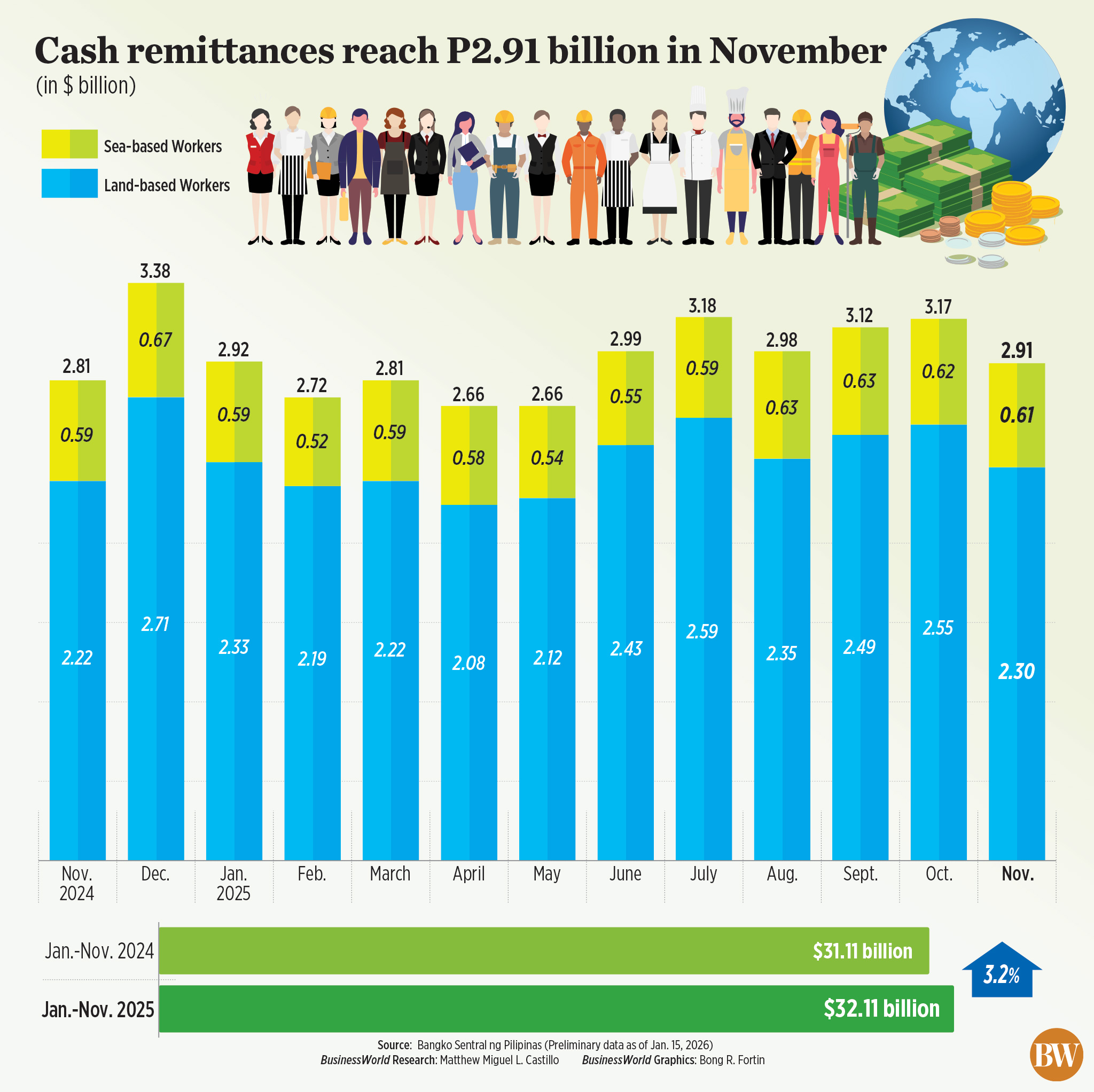
Preliminary central bank data released on Thursday showed that cash remittances coursed through banks rose by 3.6% to $2.91 billion from $2.808 billion in the same month in 2024.
This was the lowest remittance level recorded in six months or since the $2.658 billion in May.
In terms of growth, November marked the fastest pace in two months or since the 3.7% in September.
Meanwhile, remittances declined by 8.2% from $3.171 billion in October.
“November’s dip is really just a timing story,” Jonathan L. Ravelas, a senior adviser at Reyes Tacandong & Co., said in a Viber message. “A lot of the holiday money was already sent in October, which is why we saw that month heavy with remittances — partly due to pre‑holiday transfers and even typhoon‑related aid being front‑loaded.”
Mr. Ravelas noted that the month-on-month dip was not a “red flag” as it is a usual trend seen before remittances surge in December.
In November, land-based OFWs sent home the bulk of cash remittances, which went up by 3.6% year on year to $2.303 billion.
Remittances from sea-based workers likewise grew by an annual 3.6% to $606.592 million in November.
BSP data also showed that personal remittances, which include both cash coursed through banks and informal channels and in-kind remittances, rose by 3.6% to $3.235 billion in November from $3.121 billion in the previous year.
Metropolitan Bank & Trust Co. Chief Economist Nicholas Antonio T. Mapa said movements in the foreign exchange market likely drove the annual growth in remittances.
In November, the peso touched the P59-per-dollar level several times. It even closed at P59.17 against the greenback on Nov. 12, breaking the previous record of P59.13 seen on Oct. 28.
“Despite this development, remittances proved to be a solid and reliable source of FX (foreign exchange) while also translating into healthy purchasing power that likely helped drive holiday spending,” Mr. Mapa said in a Viber message.
11-MONTH CLIMBAs of November, cash remittances from migrant Filipinos reached $32.111 billion, climbing by 3.2% from $31.113 billion during the same period in 2024.
Remittances from land-based workers grew by 3.3% year on year to $25.66 billion as of end-November, while sea-based OFW remittances rose by 2.8% to $6.45 billion.
On the other hand, personal remittances in the 11-month period stood at $35.727 billion, up by 3.2% from $34.608 billion at end-November 2024.
“The United States remained the top source of remittances to the Philippines during January-November 2025, followed by Singapore and Saudi Arabia,” the BSP said in a statement.
Based on BSP data, money sent home from the US accounted for 40% of the remittances in the 11 months to November.
Inflows from Singapore made up 7.1% of the total remittances, followed by Saudi Arabia (6.4%), Japan (5%), the United Kingdom (4.6%), the United Arab Emirates (4.6%), Canada (3.5%), Qatar (2.9%), Taiwan (2.8%) and South Korea (2.4%).
The US was the top source of land-based remittances at end-November with 41.9% of total remittances. The rest came from Saudi Arabia (8%), Singapore (6.4%), the United Arab Emirates (5.7%) and the UK (4.5%).
Meanwhile, 32.2% of the remittances from sea-based workers were from the US, followed by Singapore (10.2%), Japan (7.1%), Germany (5.5%) and the UK (5.4%).
The BSP expects cash remittances to grow by 3% to $35.5 billion this year.