


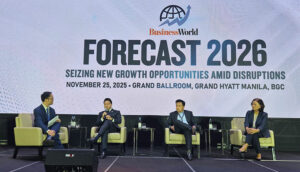
PHILIPPINE FIRMS must accelerate the integration of artificial intelligence (AI) and invest in infrastructure, talent, and governance to unlock potential gains of up to 12% in national economic output, according to industry experts.
“AI could drive anywhere from an 8% to 12% increase in the GDP (gross domestic product) of the country by 2030,” Kearney Senior Partner and Philippines Country Head Marco de la Rosa said during a panel discussion at the BusinessWorld Forecast 2026 on Nov. 25.
He said realizing that potential would require increased investments and more “democratized” access to AI technologies.

Enterprises, regulators and the government should also engage in what he described as a “healthy dialogue” on how to further improve AI adoption and governance.
“It would be great to see more venture capital or private equity monies coming into the country, investing in the AI capabilities locally,” Mr. De la Rosa said.
Ambe C. Tierro, country managing director at Accenture Philippines, said companies’ AI strategies must be grounded on technology, talent, and trust.
Organizations must have accurate data and secure cloud systems to produce relevant outputs from their AI infrastructure, she said.
“If you have a very sophisticated AI model, your data is the oxygen, so if the oxygen is bad, then the AI will not produce the right output,” Ms. Tierro said.
She also cited the need for companies to take advantage of the country’s young population by pushing AI-related upskilling.
“This generation learns fast, and so we need to capitalize on that demographic and train people as fast as we can,” she said.
Ms. Tierro added that companies must have a framework for ethics, fairness and transparency to maintain trust while using AI.
“You can make a lot of progress with AI, but as soon as you break trust, you fall backwards,” she said.
Brian Daniel Poe Llamanzares, a congressman and chairperson of the Global AI Council’s Advisory Board for the Philippines, cited the need for more local servers to host Philippine companies’ data.
“The Philippines should be looking at ways in which we can host servers here rather than us contacting them outside, not just for private sector use, but also because it’s a national security concern,” he told the panel.
He said most local companies’ data used in AI applications is currently outsourced for cloud services.
Mr. De la Rosa said the country should also expand its pool of science, technology, engineering and mathematics (STEM) graduates to become more AI-ready.
Companies should increase the availability of AI tools for their employees to ensure their data is not fed into unregulated platforms, he added.
“If it’s not available to them, they’re going to find a way to use it elsewhere,” he said. “So, make the capabilities available, and then put the guardrails around it.”
Ms. Tierro said AI integration also requires cultural transformation within companies.
“As more and more companies implement AI, they’re realizing this is not a plug-and-play technology,” she said. “It has to be embedded in the strategy. It is the strategy.”
For Mr. De la Rosa, companies should avoid both overreacting and underreacting to AI.
“There’s a general acceptance that AI is here to stay, but at the same time, it would be remiss of us to try and overreact and try to do too much without thought,” he said. — Beatriz Marie D. Cruz