


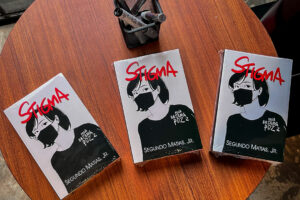
THE LATEST release by author Segundo Matias, Jr., titled Stigma: Mga Batang Poz 2, offers a glimpse into the lives of young Filipinos living with HIV/AIDS (human immunodeficiency virus/acquired immunodeficiency syndrome).
As a sequel to his 2018 novel Mga Batang Poz, it enters territory regarding the sensitive issue that hasn’t been explored before — such as available treatments and stories of women living with HIV.
In the sequel, the four “poz” (HIV-positive) teens from the first book are joined by a new character, 15-year-old Melody, as they try to navigate their health condition in a conservative Philippines.
“Mayroon akong na-encounter na 15-year-old na magpapa-test ng baby niya kasi may HIV siya (I had encountered a 15-year-old who was going to have her baby tested because she had HIV), so that inspired me to write about her,” he said at the book launch on Nov. 28.
This led to the character of Melody, who serves as the “thread” connecting the stories of the four teens from book one to her own. Though she was already in early drafts of the first book, Mr. Matias opted to shelve the character for the moment given that over 90% of HIV cases in the Philippines were male.
“I think it is very timely as well that the female character is included in book two. Compared to males, there are fewer women getting HIV, but the number is increasing — and that translates to newborns who are infected with the virus,” said Dr. Rosanna Ditangco, HIV research program head of the Research Institute for Tropical Medicine, at the panel discussion at the book launch.
“In the past, it was rarely seen, but now it’s not uncommon. If you look at statistics, there are newborn babies who are reportedly getting HIV every month, so this is very relevant not only for teenage pregnancy, but for women in general,” she added.
As a follow-up to Mga Batang Poz, which tackled the anxiety and fear of possibly having HIV, the narrative in Stigma differs by zeroing in on how these teenagers face their reality and the judgment of society. It begins with Melody joining a group chat that serves as a digital refuge for young people like her, where she meets Luis, Enzo, Gab, and Chuchay.
A RISE IN CASESAs of this year, the Philippines has reported having the fastest-growing number of HIV cases in the Asia-Pacific region. It went up by 550%, from just 4,400 in 2010 to 29,600 in 2024, which also speaks to increased awareness with more people getting tested.
In line with this situation, Stigma: Mga Batang Poz 2 aims to “challenge prejudice and call for compassion in the age of social media and digital connection.”
The first Batang Poz novel inspired a 2019 iWant miniseries starring Paolo Gumabao, Mark Neumann, and Awra Briguela. Mr. Matias said that he’s open to seeing the sequel adapted as well, be it on TV or even theater.
He explained that, for the first book, what drove him to write was the fact that he knew nothing about the reality at first, citing a memory of walking into a Department of Health facility and seeing the poz teens wear masks or hoodies to conceal their identities.
“Kaya siguro mas nasulat ko pa ito lalo ay dahil wala akong nalalaman. (I guess I was really able to write about this because I didn’t know anything),” he said. “It pushed me to study the issue and handle it with sensitivity.”
The sequel’s completion and release was also delayed by the coronavirus pandemic. He had consulted with Dr. Ditangco and concluded that people were still preoccupied with another virus and would not be ready to hear more about HIV/AIDS.
After polishing the manuscript, Mr. Matias ensured that it would have “deeper and more technical discussions” compared to the first book.
“In Stigma, I made it a point to provide clear guidance on staying safe. I want to highlight the importance of PrEP (pre-exposure prophylaxis) as treatment and consistently advocating condom use for protection,” he said. “While the first book conveyed the horrors surrounding HIV, the second installment focuses on empowerment and dismantling stigma.”
THE POWER OF STORYTELLINGDanvic Rosadiño, head of programs and innovations for nonprofit organization LoveYourself, stressed the need for factual information regarding HIV/AIDS. (LoveYourself offers care, testing, and treatment for people living with HIV or PLHIV.)
“Social media has the great power to change the flow of information, but with great power comes great responsibility,” he said. “We have to be careful about what we post. It’s a major factor in destroying stigma in this day and age.”
He added that dismantling stigma will also encourage the approximate 40% of people who have not been tested for HIV. “Mas marami pa tayong matututunan at matutulungan doon sa pwede pang magpa-test(We still have a lot to learn and to help from those people who have yet to be tested).
Award-winning screenwriter and National Artist for Film Ricky Lee graced the launch and shared how fiction like Stigma fosters empathy, compared to social media where people tend to judge quickly.
“Sa nobela, sa pelikula, dahil mahaba ‘yong tinatakbo ng kwento, natututo tayo na ‘wag mag-judge agad. Natututo tayong makipamuhay sa mga karakter at maintindihan sila. (In novels and films, because of the length of the narrative, we learn how not to judge right away. We learn how to live with the characters and understand them),” he said.
“Matuto tayong magkaroon ng empathy at makilala sila bilang mga tao kagaya natin (Let us learn to have empathy and get to know them as people like us).”
Segundo Matias, Jr.’s Stigma: Mga Batang Poz 2 will be available soon. It is published by Lampara Books. — Brontë H. Lacsamana